| Deals of the Year 2026: Deals Awards 2026 reflect the huge evolution and growth of Ireland’s financial services industry |
Back |
| Converging trends, notably digitalisation of finance, AI, and general fintech investment are supplementing rising deal activity across the categories in the Finance Dublin annual Deals of the Year Awards, as 69 deals are recognised in Mergers & Acquisitions, Debt Capital Markets, Equity Capital Markets, Loans & Financing, and Financial Services. |
From major bond offerings to billion euro plus mergers and acquisitions, from residential mortgage securitisations to aviation finance deals, from the final disengagement of the State from AIB Bank to a plethora of green bonds and loans, and from UCITS to tokenisation, Ireland’s financing and financial services sector remained in rude health in 2025 to judge from the quality and depth of activity shown in Finance Dublin’s 2026 Deals of the Year Awards.
Here is just a taste of some the award winners, all 69 of which are profiled in this issue of Finance Dublin (see page 20, where the first of the listed deals, the €1.4 billion “off the market” acquisition of Dalata Hotels) is profiled. 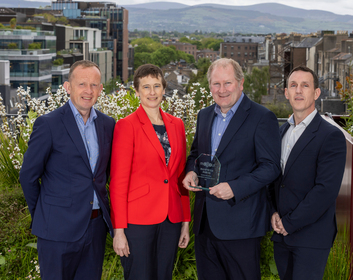 | | [L-R] Niall Garvey, Managing Director, Corporates and Institutions, Danske Bank Ireland; Anne Marie Kean, Group Treasurer, ESB; Steve Allen, Group Funding Manager, ESB; Sean Lenihan, Senior Relationship Manager, Corporates and Institutions, Danske Bank Ireland |
Mergers & Acquisitions
Merger and acquisition activity in 2025 in Ireland might not have an event of the scale of the blockbuster $25 billion merger of Smurfit Kappa and WestRock in 2024, but there was still plenty of activity. And many of the deals detailed in this years’ Deals of the Year were both newsworthy and innovative whether they involved plcs or the private sector.
One of the most innovative larger scale M&A transactions was the acquisition by the Nordic consortium Pandox/Eiendomsspar of Dalata Hotels for €1.4 billion. In an unusual move which some in the M&A industry believe may become more commonplace in Ireland in the future, the Nordic group decided not to participate in the formal sale process put in place by Dalata and instead pursued a novel off-market approach. In this manner, the transaction was pursued on an “outside-in” manner to a degree that Pandox/Eisendomsspar was able to out-manoeuvre rival interested parties without ever getting involved in the formal process, a tactic in M&A is often discussed but rarely seen.
The Dalata acquisition also won a Deal of the Year for the debt financing involved in the transaction. The finance included a €1.165 senior secured bridge loan which set a new benchmark for lender side execution in Irish public to private deals. The progress of the acquisition from an initial hostile approach to a recommended €1.4 billion offer required a complete re-engineering of the financing package, which apart from the €1.165 million bridge loan included a €473 million debt/equity element.
It’s a reasonable assumption that few outside the legal services sector had even heard of Brightflag before it became one of the biggest private sector M&A deals of 2025 when Wolter Kluwers bought the Irish legal software group for €425 million after an auction process. Johnson Hana is another legal software group which few outside the legal sector would be aware of, but this Irish company – backed by institutional and state investors - was sold to the American group Eudia for an undisclosed sum which involved cash, rollover equity and share options.
The NYSE listing and $1.05 billion equity fundraising by NIQ Global Intelligence Group was notable as it was the only IPO last year by an Irish-incorporated US-listed public company. This was the first IPO of an Irish public limited company on the NYSE since 2021 and was one of first ever Irish issuers to prepare its SEC registration statement on a ‘domestic issuer’ basis using the Form S-1. The transaction marked the ongoing trend of the Irish plc as a popular and dynamic legal form for businesses choosing to trade their shares in a range of listing venues.
There have been a number of highly successful spin-outs over the years of Irish third level campus companies and the Trinity College spin-out ProVerum is one of that select group. During 2025, ProVerum – which has developed a technique for the treatment of prostate cancer – raised $80 million in funding from new and existing investors. New investors included Orbimed, ISIF and MVM Partners who joined existing investors Enterprise Ireland, Atlantic Bridge, Gilde Healthcare and Lightstone Ventures in providing the funding to support ProVerum’s expansion and product development.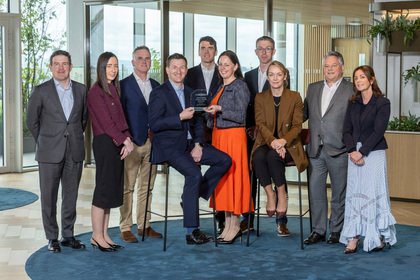 | | A&L Goodbody's winning deals team. [L-R] Stephen Carson, Niamh McMahon, Peter Murray, Charles Carroll, Neal Breslin, Marie O'Brien, Ronan Lyons, Berni Hosty, Paul White and Sinead O'Connor. |
Acquisitions by Irish companies in New Zealand are something of a rarity – the former Independent News & Media’s foray into the NZ media market some 30 years ago being a notable exception – so Dawn Meats’ acquisition of an initial 65% shareholding in the NZ meat co-operative Alliance Group is a worthy Deal of the Year. One can only guess the air miles notched up by Dawn’s CEO Niall Browne and his team in completing this deal – it’s a long long way from Dawn’s HQ in Waterford to the Alliance HQ in Invercargill at the southern tip of New Zealand’s south island.
Mergers and acquisitions involving co-ops are as complex in NZ as they are in Ireland, and Dawn had to cope with the same 75% vote in favour obstacle as well as the opposition of a small ginger group of Alliance shareholders opposed to the deal.
The eventual combination of the two companies means that Dawn now has an enlarged business straddling both northern and southern hemispheres and significantly strengthens its position in key global markets.
In 2024, the complex deal that saw Kerry Group finally sell its dairy business to Kerry Co-op was a worthy winner of a Deal of the Year award. Last year, Tirlan Co-op, the largest shareholder in Glanbia plc, also won a Deal of the Year for a complex interlinked transaction which saw the co-op sell 17 million Glanbia shares for €230 million concurrent with a tender offer to repurchase the outstanding €250 million of the co-op’s secured exchangeable bonds that were listed on the Frankfurt Stock Exchange. The equity element of the transaction saw Tirlan reduce its shareholding from 24% to 18% after a bookbuilding exercise generated strong demand for the shares from both new and existing shareholders. Significantly, Glanbia itself used its existing buyback authorisation to participate in the share placement by Tirlan and then cancel the bought back shares.
Greencore’s ?1.2 billion merger with the Icelandic ready foods group Bakkavor was notable for its financial complexity which ultimately culminated in an enlarged group 56% owned by Greencore shareholders and 44% by Bakkavor shareholders. The merger came through a recommended cash and equity offer by Greencore which implied an equity value for Bakkavor of ?1.2 billion. The deal involved a ?825 million financing package made up of three different term loans of varying maturities, distinct pricing margins and fee structures.
By now Ireland has been long established a global centre for aviation finance, and that global presence was reinforced in 2025 with the acquisition by Dubai Aerospace of Nordic Aviation Capital for €1.7 billion. The transaction represented a continuing consolidation in the aircraft leasing market and resulted in a significant expansion of DAE’s fleet.
Another Irish-based aircraft leasing group, Avolon, took advantage of strong demand in the debt market, increasing a term loan issue and RCF from an initial €1.1 billion to €1.34 billion that will fund further expansion of its aircraft fleet. Seventeen banks were involved in the transaction, including seven new banks. The facility was split between an unsecured drawn term loan tranche and a revolving tranche, giving Avolon access to both drawn capital and the flexibility of the revolving capacity enabling it to fund its business in the most efficient manner.
DCC itself is currently the focus of a €5.7 billion takeover bid from private equity group Energy Capital – a bid it has rejected – and the group continued the refocus of its business during 2025 when it sold its healthcare business to private equity group Investindustrial for €1.2 billion. 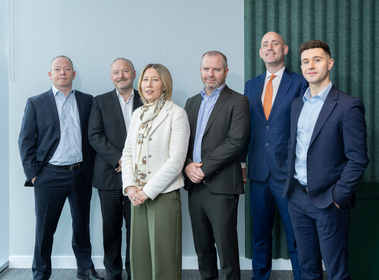 | | BNP Paribas Ireland's winning deals team. [L-R] Cormac O'Reilly, Director, Global Banking; Derek Kehoe, CEO; Caroline Carty, Director, Global Banking; Liam Doherty, Director, Global Banking; Billy Quinlan, Head of Global Banking; and Glen Thorpe, Global Banking. |
This deal involved a complex carve-out of the healthcare business and highlighted the attractiveness of healthcare assets to private equity investors. DCC shareholders also benefited from the sale with part of the proceeds of the disposal being used to fund a €800 million share buyback.
Not all Finance Dublin Deals of the Year proved to be an unqualified success - in the short term at least - and last year’s award for Flutter’s listing on the NYSE might fall into that category given the collapse in the Flutter share price from $300 to near $100 since the listing. American financial markets can be an unforgiving place for underperforming companies and the Flutter share price has been decimated by a market reaction so negative that it has knocked two-thirds off the gaming group’s market capitalisation in the space of a year. Flutter did, however, continues its European expansion during 2025 when it obtained a 30% share of the Italian gaming market with the acquisition of the Italian group Snaitech.
Originally established 50 years ago in Cork by Denis McHugh as a supplier of farm detergent products, Carbon Group has over the years developed into a major international supplier of essential products and ingredients to the pharma, bio-pharma and medical devices industries. The acquisition of Carbon Group by the American company Shrieve marked a pivotal step in expanding its presence in the specialty chemicals sector and gives it immediate access to established relationships in key end markets and also helps it to scale its European footprint to meet customer demand.
Another private sector deal involving a long-established Irish company was the acquisition of the Shannon-based medical products group Smithstown Engineering by the American investor Graham Partners.
The transaction was very challenging and innovative for a number of reasons. It involved the simultaneous acquisition of trading entities in the Smithstown group in both Ireland and Poland and involved a detailed Irish and Polish due diligence exercise, which involved managing multiple teams across different jurisdictions.
The deal terms included a complicated earn-out pricing structure and also included a complex ‘rollover’ element, requiring a detailed tax analysis to ensure that the structure was as efficient as possible for all parties involved.
Private equity investment in privately-owned Irish companies has been a major feature of Irish M&A activity in recent years, as it has been globally.
Another PE investment in an Irish company was the acquisition by TowerBrook of a minority stake in GMC Utilities, a company with a major presence in the utilities sector and which had a business valued at €140 million at the time of the TowerBrook investment.
Debt Capital Markets & Loans & Financing
During 2025, there was one bond issue that stood out from most of the 69 deals awarded in the Deals of the Year – the record breaking €2.4 billion revolving credit facility put in place by the state power utility, the ESB.
This was the largest RCF ever negotiated by an Irish state entity and involved a syndicate of 15 Irish and international banks. The €2.4 billion RCF also included a €500 million accordion option with an option to extend the facility from 2030 to 2032. The terms of the RCF also contained specific targets directly linked to the ESB’s Net Zero by 2040 strategy and replaced an existing €1.4 billion RCF.
Also in the RCF market during 2025 was the NYSE-listed Dole, the product of the 2021 merger between Dole Inc and the Fyffes spin-out Total Produce plc. Dole refinanced a $850 million RCF with a new $600 million RCF and a $250 million term loan. The loan structure allowed Dole to source debt across different regions and was structured to reflect Dole’s current lower leverage profile compared to its previous facilities were put in place after an acquisition and leverage was at a higher level.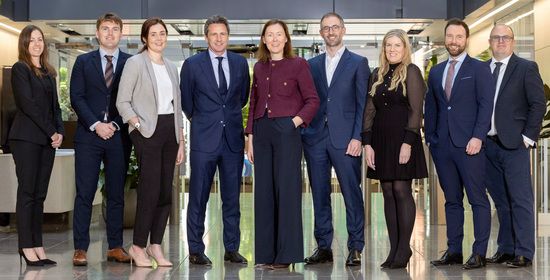 | | Walkers' Joanna Taylor, Country Lead, Professional Services; Owen O'Hanrahan, Associate; Seana Donaghy, Of Counsel; Jonathan Sheehan, Partner; Noeleen Ruddy, Partner; Ian McNamee, Partner; Nicola Byrne, SVP, Professional Services; Ben Lynch, Associate; Andrew Traynor, Partner. |
Another major loan deal involved low-cost carrier Ryanair which refinanced an existing €750 million RCF with a new 5-year facility involving 17 lending institutions. The funds are targeted for general corporate purposes. The healthcare services group Uniphar was also in the debt market when it upsized and extended its term loan and RCF to €700 million. The facilities included a new €150 million term loan, an extension of an existing €400 million RCF and a €150 million accordion facility. This funding may be drawn down in the future to fund, inter alia, acquisitions by Uniphar.
There was continued market interest in green bonds from both borrowers and lenders keen to highlight their ESG credentials, with AIB, Permanent TSB, Marlet Property and housebuilder Cairn Homes all issuing green bonds/loans of varying sizes. The single biggest green bond issue was by AIB which completed one of the tightest-priced issues of its kind in 2025 when it raised €1 billion Tier 2 capital. The order book for the AIB green bond issue was almost three times oversubscribed with commitments from almost 200 accounts across 20 jurisdictions.
Permanent TSB – currently the focus of a recommended €1.6 billion takeover from the Austrian bank Bawag, was another financial institution to tap the green bond market when it completed a €300 million issue at very tight pricing. The deal also included a tender offer for the bank’s outstanding 3% 2031 Tier 2 notes.
Another major green loan involved Marlet Property, one of Ireland’s largest property development groups. Marlet assembled a three-bank syndicate for a complex €268 million refinancing of its landmark College Square development in downtown Dublin involving senior, mezzanine and super junior debt secured against the development. The refinancing qualified as a green loan as College Square is considered one of the most sustainable buildings in Ireland.
Kennedy Wilson was another developer in the debt market when it arranged a new €472 million financing package secured on a package of its high profile property assets in Dublin and Cork. House builder Cairn Homes was also in the green loan market when it refinanced an existing €327.5 million loan and added a further €75 million bringing the size of the new green loan to more than €400 million.
Bain Capital, one of the global giants in the investment management industry joined forces with SMBC to establish a new European loan platform providing up to €1.3 billion in senior secured credit facilities to corporate borrowers in the UK and Europe. In the mortgage securitisation sector of the debt markets, the American group One William Street completed a €405.8 million securitisation of reperforming Irish mortgages.
Barings notched up a first when it launched a €401 million collateralised loan obligation (CLO) which was the first of its kind to combine a multicurrency structure. The novel multicurrency format of this transaction – featuring euro and sterling tranches – represented a significant innovation in the European private sector CLO market.
CRH – now listed on the NYSE and with the majority of its business now US-based, also made a return to the US bond markets with a $3 billion secured notes offering. The notes had maturities of 5, 10 and 30-year and attracted huge market interest with an order book of some $13 billion. 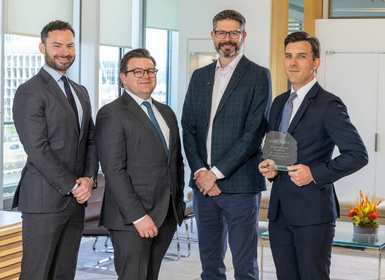 | | L-R: Cillian O'Boyle (partner, Real Estate), Ruadhán Kenny (partner, Disputes and Investigations), Russell Rochford (partner, Employment, Pensions and Benefits), Paul Carroll (partner, Finance and Capital Markets) |
This allowed CRH to increase the size of the note issue from an initial $2.5 billion to $3 billion.
Public Private Partnerships to develop second and third-level facilities have been a feature of the education sector in Ireland, and this pattern continued during 2025 when a €379 million PPP was finalised to develop five academic buildings on five campuses in Galway, Letterkenny, Waterford, Carlow and Limerick. The 25-year design, build, finance and maintain (DBFM) contract was awarded to the Invesis Consortium, comprising InvesisCooperatie and two arms of the building group BAM.
More than 16 years after the bank was rescued by the Irish taxpayer after the 2008 financial crash, AIB Group finally closed its own chapter of the crash saga after a three-stage share sale which saw the State shareholding in the bank fall to zero. The total value of shares sold by the State in 2025 was €2.16 billion, made up of an initial €652 million accelerated bookbuild, a €1.2 billion directed share buyback, and a second accelerated bookbuild worth €302 million. The saga of the 2008 banks bailout will probably close finally later this year following the recommended offer by Austrian bank Bawag for Permanent TSB, where the State still holds a 57.5% interest and has backed the Bawag takeover offer.
PE-backed Azets has been to the forefront of consolidation in the financial services sector across Europe and prior to the acquisition of the Cooney Carey accountancy group in 2025, already had a significant presence in Ireland. The combination with Cooney Carey created an enlarged group employing more than 300 people across three locations.
Renewable energy deals won three separate awards in the 2025 Finance Dublin Deals of the Year. Lirion Power, a new Irish renewable platform won an award for its €156 million acquisition of a portfolio of wind farm assets from Greencoat Renewables. The transaction has been touted as a landmark in the Irish renewable sector bringing in a new presence in the market and also marking Greencoat as a strategic market seller.
In the solar energy segment of the renewable sector, ILOS Energy assembled a €143 million debt facility to fund construction of a 217MW solar farm in Ballyhea, Co Cork which spans about 500 acres and will generate power for around 39,000 homes. Also in the solar energy sector the Roche-family backed NTR Group which finalised an initial €65 million financial package to support the development of solar and battery storage assets in Ireland.
The 2024 Finance Dublin Deals of the Year included a number of financing transactions aimed at increasing the provision of housing, particularly low-cost housing. That pattern was maintained in 2025, with three housing-related loans and finance deals winning Deal of the Year awards. The Irish Strategic Investment Fund (ISIF) linked up with real estate finance provider Activate Capital with a €770 million financing package targeting the social housing, cost rental, affordable purchase, private rental and private purchase sections of the housing market.
In another deal, Home Building Finance Ireland raised a further €200 million on top of its initial state funding of €730 million. This was the first time that HBFI tapped debt markets to fund a growing pipeline of housebuilding projects. The Irish Homebuilding Equity Fund, backed by Bank of Ireland and ISIF, invested €20 million in three housing developments in Dublin, Cork and Kildare which will deliver 1,600 new homes, a mix of private, affordable and social housing, over the next three years
Ireland in recent years has become a global centre for a variety of financial activities and instruments, notably aviation finance and asset securitisations. Is Ireland now going to become a global centre for tokenisation, and other blockchain based applications which are now rapidly becoming part of the financial services mainstream? The Czech group Confirmo last year became the first crypto asset services provider (CASP) to be licensed in Ireland, allowing Confirmo to deliver regulated services to and from bank accounts, enabling users to move between euros, dollars and stablecoins. |
|
|
| |
|